skip to main |
skip to sidebar
 Hanoi - oh Donna Donna When I first hit the road of Hanoi, one thing I remember is the Donna Donna song, my mom's favorite. Written by Joan Baez popular in the mid 60's. Hanoi is pretty much alike with what the song tells. Packed with bicycles, the Hanoi road is distinguished from any other world capital cities. ]
Women wearing colorful traditional costume and Vietnamese corn-hat while cycling down the road gives a strong nuance and identity to the city. As well, sign of a strong Communist influence, as Baez implicitly portrayed in his lyrics. Another identity of this city is sports. Everyone loves sports. Every morning elderly people gather in the public park doing exercise (a kind of Indonesia's SKJ in the early 90's). The younger people do badminton or soccer games, or just run for jogging. At another corner of the park near a lake, grandies do Chinese tai chi exercise, beautifully performed with red fans danced in their hands.
Also at night, people gather at the street banks for dinner with their families and relatives. Outside their house. Basil's fragrance is another identity; soups, shrimp rolls, pho (noodles) and beef alike are in flavor of those basils. This street's smell distinguished it from Delhi (incense) and Jakarta (cigarette). O Hanoi Donna Donna. People are so friendly, like my mom's story of those in the seventies. Eventhough they don't speak English but their smiles saying that we are welcomed as a family. In the night market, we sit together with the street vendors, talking about education and children, food and tourism and their hopes of the future Viet nations.
I was overwhelmed with their sincerity and life spirit. Jomima took some bracelets made of stones which was decorated with colorful characters and painting. They made it special for her. I myself prefer to enjoy the talks and eyeing on the crowds... and sometimes take a few shots.
The night market has turned its function from a mere exchange place into a system to interact and show-off their communality. Vietnam has shown the world that Communist could co-mingle with prosperity. And they portray it beautifully.
 Who says fantasy never comes to reality? Last year this was my fantasy, The Great Himal.
Until over midnight, when silence was the only presence, I could finally close my eyes but not for that long. I was pretty scared, honestly. I got to be accustomed to breathe with only one third oxygen intake into my lungs.
Theoretically, I have to climb higher, say 4,500 m first then go down at least 500 m to the altitude of 4,000 m for overnight stay and acclimatising. But this time, there's no time to climb higher, the weather and time just did not favorable to do that. The result was, whenever I reached the 4,000 m basecamp, I had to stop the trek and stayed overnight. My lungs were not yet adapting to this new environment and demanding more oxygen, which was not available!
Fortunately, I could manage the acclimatising process within a few hours. I shortened my heart beats and totaly did relaxing all my bodies to save the oxygen. A few hours later, my body could finally adapt to this new altitude and I could feel my blood circulating as normal. No more headache and vomitting.
In the morning, I was okay. The same story applies to the extreme cold acclimatising process. Spending the rest of my life in the equator weather of 30-35C, I had to push myself to the limit dealing with sub zero temperature, which once reached -16C. How's that feel? It's damn cold! Twice as much colder than your freezer box. But I survived. How?

I learned that it is not the extreme temperature that makes you cold, but your body itself. When you get into an extreme cold environment, one thing to note is to prevent your body heat leaking outside, meaning that you have to keep your body warmth inside your inner clothing. That's why you need thermal clothes. A material that could retain heat and prevent it from evaporating. At once it should be able to 'breathe' your sweat.
No matter how cold it may be, when we are climbing, as our calories are burnt, we produce heat and sweat. Good thermal clothes will retain the heat but releasing the sweat for evaporation, it keeps your body dry. If sweat cannot be released, it could turn to be very cold and absorb your body heat. A fatal mistake.
Amazingly, our body is a supermachine. It can adapt very quickly to the environment. Its versatility provides you with comfort out of an extreme temperature. When I reached 3,500m in a mid-day, the temperature was nearly zero because of the breeze from the surrounding ice mountains. I put on my cloves and thermal cap, and down jacket for sure. However after a few hours, under the same temperature, I could simply wear light jacket without cloves and cap. I was then feel comfortable with that cold.
It happened when I went higher and higher. I believe that's why they suggest acclimatising one night every 1,000m above 3,000m altitude, to let your body find its pattern adapting the extreme environment.
What an experience! Thanks Himalaya.
 Mon belle Jomima
Luang Prabang, a tranquil town in the deep valley of Laos, where two giant rivers of Mekong and Kham are merged. The delta land is then named Luang Prabang, a town with thousands of temples.
The night was falling as we approached the Luang Prabang airport. We (I and Jomima) were on board Lao Airlines from our departure point of Hanoi after spent a week in that lovely capital city of Vietnam.

We hardly saw any lights as the plan approached the runway, indeed Laos is surrounded by undeveloped forests. The roaming engine of MA60 China-made 58-seaters aircraft indicated that we were about to land. What we saw then was a humble terminal building with 4 or 5 officers (two of them were immigration officers). I learned lesson number one : they trust people. Even you can easily walked out the airport thru an open gate without anyone noticing.
 MA60 safety card
 View from my balcony
 Emily
Emily
 Our stay for three days in Luang Prabang was very much an amusing experience. We went to a spa, where I had a shoulder massage. It was the best massage I ever had! So relaxing that I fell asleep just a few minutes after starting. I learned that I have just visited one of the most popular spa destination in Asia.In terms of tourist spots, Luang Prabang has many to visit. On the first day we decided to go cruising the river Mekong, into an ancient cave at the river bank, known for its Buddhist statue inside. It was Pak Ou cave. The trip took about three hours I guess, we started shortly after having breakfast at "Croissant d'Or" and arrived at the cave just before lunch time.
 While everyone on boat was asleep as the breeze touched their faces, I let my hands down to the water, and taste the touch of the golden glowing Great Mekong stream. Mekong history has brought us here, from Hainan in China, Hanoi in Vietnam and now Luang Prabang (Laos). Still, we have to continue the journey to Cambodia and Thailand, where the Great Mekong meets its eternity with Indian Ocean. On the second day, we decided to go to the forest and see the Quang Xi waterfall, said to be the tallest in the country. Bound with a van of 9 other people, we talked a lot with a New Yorker. He's traveling alone, spending two weeks in Luang Prabang before leaving back to NYC through Vientiane and Bangkok.
 Quang Xi was not so much special. We need to climb uphill for about one hour before getting into the site. The waterfall itself was less interesting compared to the road trip journey where we saw wild elephants and stop by in a handicraft village. Here I captured a poor families and their kids running across to greet and tout the tourist selling their local products.But the journey must continue. On board Vietnam Airlines Fokker-70, we left Luang Prabang to Siem Reap.
 Bye bye Luang Prabang.
 Hibiscus with its dew drops that early morning when we left Thongbay Guest House
 Sisavangvong road
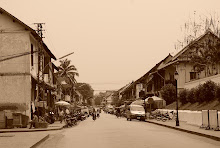
Sisavangvong, the heart of Luang Prabang... One of a kind place that reserves some space in my mind and call me for returning.Sisavangvong is the name of an outcasted King of Luang Prabang. He fled the country when people toppled him down in 1945. He is a life-time supporter of French colonial in Laos until 1945. However according to the history script. in 1946 French ruler install him once again to become a king, even for the entire kingdom of Laos. This reign ended when communist took over the country in 1974, as the red wind blew from the neighboring Vietnam.
 French-styled shop house
 One of the pavilions at Royal Palace, now a National Museum
Every 6 until 9PM, there's a night market at the North side of the street, right in front of the Royal Palace which now become a museum, after King Sisavangvong left the country. Souvenirs, t-shirts and foods, even books and herbs are here for sale.I never know, but this place is one of a kind. I always miss to return. In fact, Sisavangvong is just a street with its French-touch old 2-storeyed buildings. Not many people come visiting, not many things to see, not many activities to do either. But I insist that I will return.Maybe because of its history... maybe because of the people I met. Great people, the New Yorker, the Aussie Family and the Emily's.Sisavangvong, the Heart of Luang Prabang.Travel Fact :How to get there : flight from Hanoi (Vietnam Airliner, Lao Airlines) US$180/one way - 1.45 hours. flight from Bangkok (Bangkok Air, Siem Reap Airlines) US$215/one way - 2.30 hours. flight from Siem Reap - Cambodia (Siem Reap Air, Khmer Air) US$115/one way - 1.0 hour.Hotel : US$30/nightCurrency : US$ and Laotian Kip (1US$ = 8,000 kip)
Having a cup of cappuccino at overcrowding La Rambla. On an afternoon, while understanding why I am here alone, in Barcelona.




.JPG)